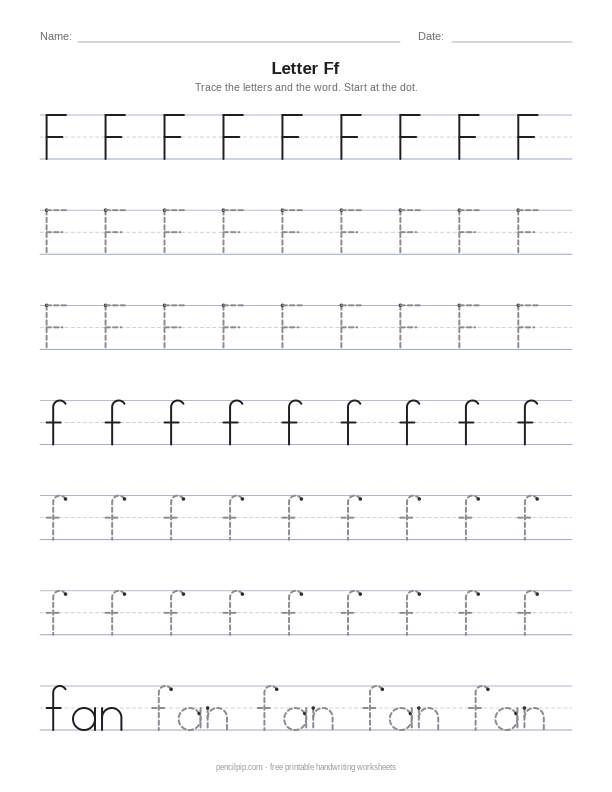
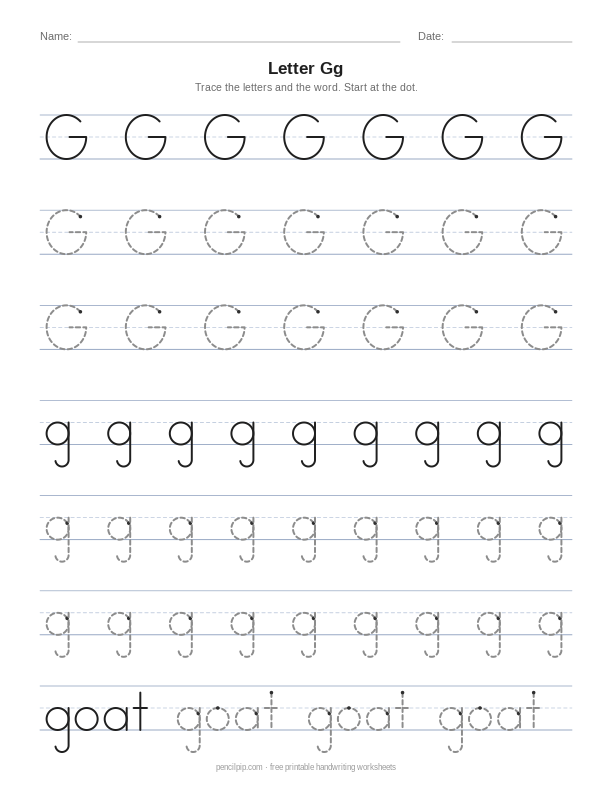
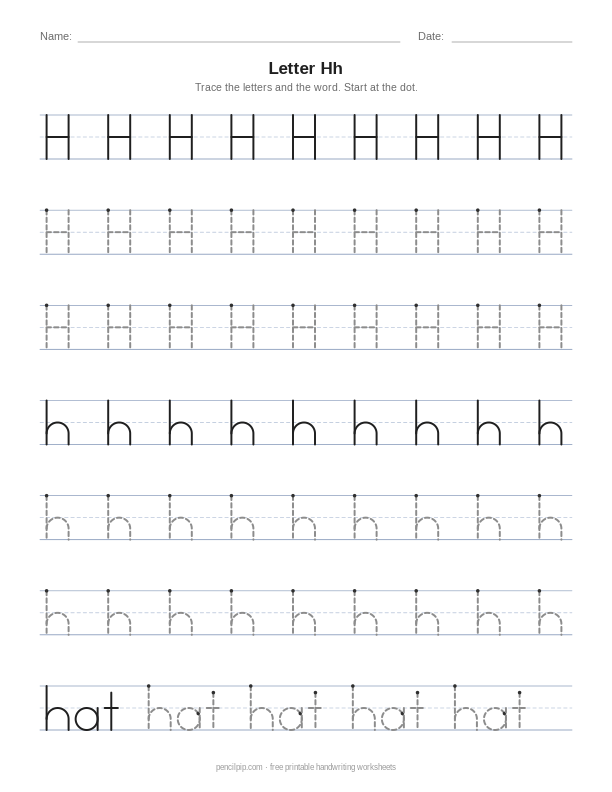
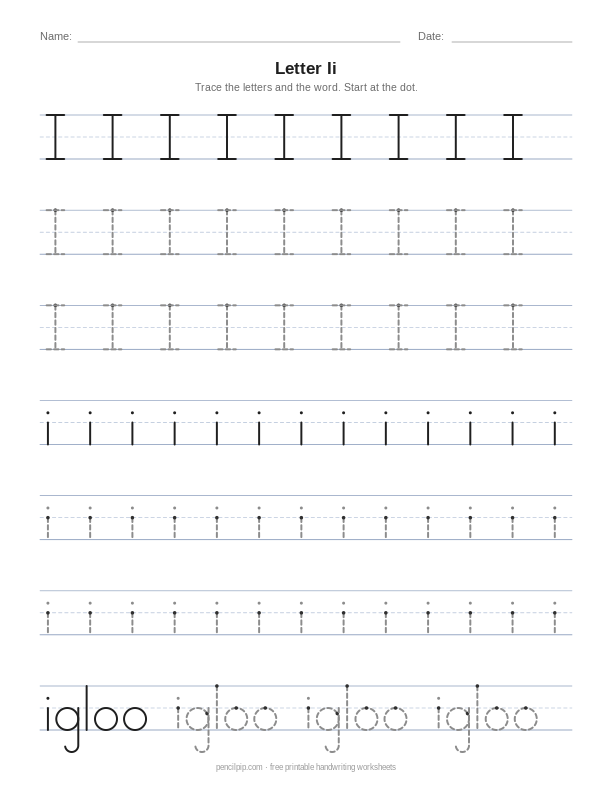
Letter D Tracing Worksheet
Change the size, paper or tracing style, or make each line a little harder, before printing.
About this worksheet
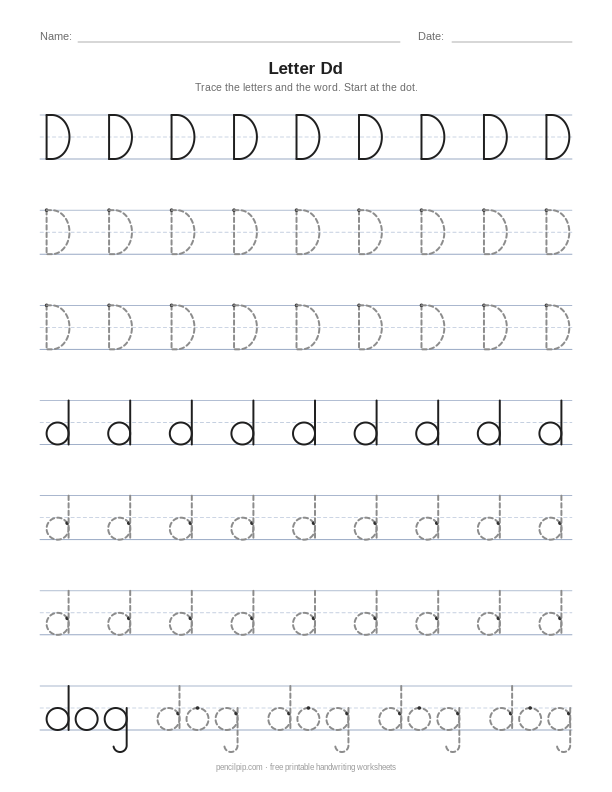
This page practices uppercase D and lowercase d, then the word “dog”. Each section starts with a solid example — the dots and arrows show where to start and which way to go — followed by letters to trace. For the last two lines, cover the letters above with your hand and write Dd on your own; only the starting dots are left to help.
How to write D and d
Start at the green dot and follow the arrow. Numbers show the order of the strokes.
Uppercase D
Pull down from the top. Go back to the top and make one big curve around to the bottom.
Uppercase D starts in the top left corner with a big line down, just like B, E, F, H, K, L, M, N, P, R and U.
Lowercase d
Circle back and around, then go up to the top line and pull straight down.
Lowercase d starts with a curve that goes up and back around to the left, just like a, c, f, g, o, q and s.
- The curve of D always goes on the right side of the line.
- b and d are the letters children mix up most. d starts with a c-curve, then the tall line — “c, then line.”
Mixing these up now and then is normal until about age 7. If it still happens often in 2nd grade, mention it to your child’s teacher.
Practicing a name? Make a name tracing worksheet with your child’s own name. Popular names that start with D: Daniel, David, Dylan, Delilah, Daisy, Dominic, Damian, Dean, Declan, Dawson.
How to use this worksheet
- Say the letter’s name and sound, then say the word on the page.
- Trace the solid example with a finger, starting at the dot, and say the starting direction as you go.
- Trace the dotted uppercase and lowercase letters with a pencil, starting at the dot each time.
- Trace the letters and the word. Then cover the letters above with your hand and write them on their own; only the starting dots are left to help.
More tips and common questions: Letter Tracing A–Z guide